

Allowing Internet Traffic Only to a Specified Port
Application Scenarios
For security purposes, you need to allow traffic only from certain ports (such as ports 80 and 443) to access cloud resources.
This section describes how to configure CFW for refined management and control on cloud resources, allowing all EIPs to access port 80 of an EIP (xx.xx.xx.1).
Configuring CFW to Allow the Access Traffic from the Internet to a Specified Port
- Purchase the CFW standard or professional edition. For details, see Purchasing CFW.
- (Optional) Switch to another firewall instance: Select a firewall from the drop-down list in the upper left corner of the CFW console.
- Enable protection for the EIP (xx.xx.xx.1).
- In the navigation pane, choose . The EIPs page is displayed. The EIP information (both IPv4 and IPv6) is automatically updated to the list.
- In the row of the EIP (xx.xx.xx.1), click in the Operation column.
- Configure protection rules.
- In the navigation pane, choose .
- On the Protection Rules > EIP tab page, click Add Rule. On the Add Rule page, configure protection information and set other parameters as needed.
Configure the following protection rules:
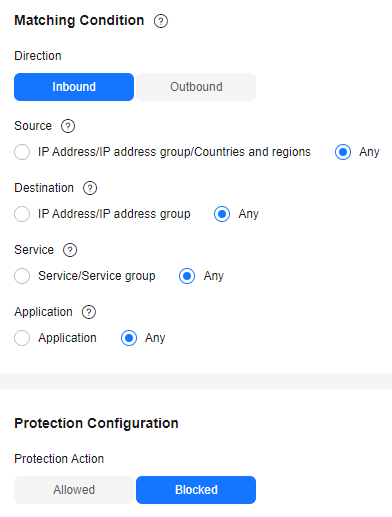
- One of the rule blocks all traffic, as shown in Figure 1. The priority is the lowest.
Table 1 Blocking all traffic Parameter
Example Value
Description
Direction
Inbound
Direction of the protected traffic.
Source
Any
Origin of network traffic.
Destination
Any
Receiver of network traffic.
Service
Any
Protocol, source port, and destination port of network traffic.
Application
Any
Protection policy for application layer protocols.
Action
Block
Action taken when traffic passes through the firewall.
- The other rule allows the traffic from port 80 of EIP (xx.xx.xx.1) and has the highest priority.
Figure 2 Allowing access traffic to port 80 of xx.xx.xx.1
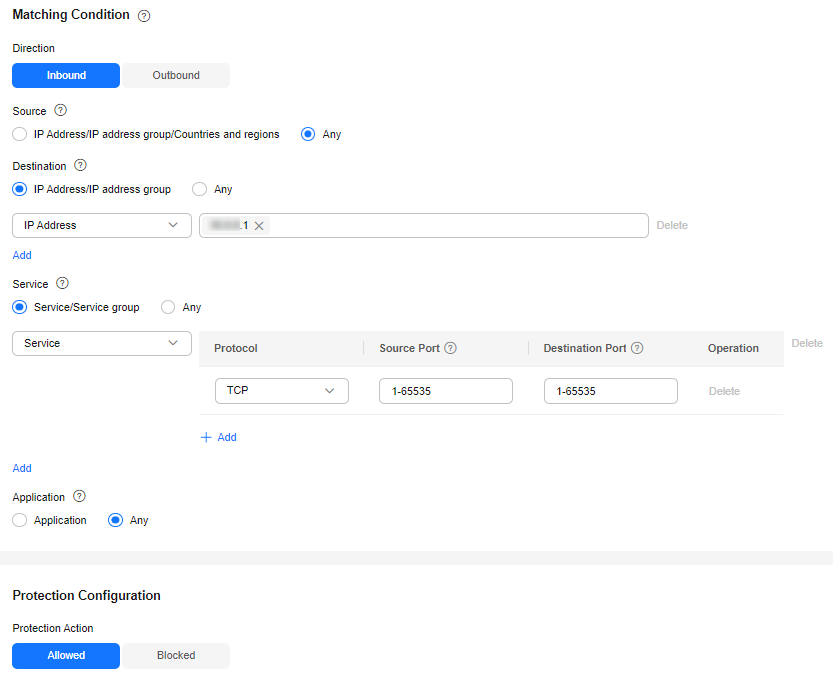
Table 2 Allowing access traffic to port 80 of xx.xx.xx.1 Parameter
Example Value
Description
Direction
Inbound
Direction of the protected traffic.
Source
Any
Origin of network traffic.
Destination
Select IP address/IP address group/Countries and regions. Select IP address from the drop-down list, and enter an IP address (xx.xx.xx.1) in the address text box.
Receiver of network traffic.
Service
Select Service/Service group. Select Service from the drop-down list. Set Protocol to TCP, Source Port to 1-65535, and Destination Port to 80.
Protocol, source port, and destination port of network traffic.
Application
Any
Protection policy for application layer protocols.
Action
Allow
Action taken when traffic passes through the firewall.
- One of the rule blocks all traffic, as shown in Figure 1. The priority is the lowest.
- View the rule hits in access control logs.
In the navigation pane, choose Log Audit > Log Query. Click the Access Control Logs tab.

In the rows where Destination IP is xx.xx.xx.1, the corresponding Action is Block.
References
For details about how to add other protection rules, see the parameter description in Adding a Protection Rule.
Feedback
Was this page helpful?
Provide feedbackThank you very much for your feedback. We will continue working to improve the documentation.See the reply and handling status in My Cloud VOC.
For any further questions, feel free to contact us through the chatbot.
Chatbot


